Rough Clean vs. Final Clean vs. Touch-Up: What Contractors Should Book, and When

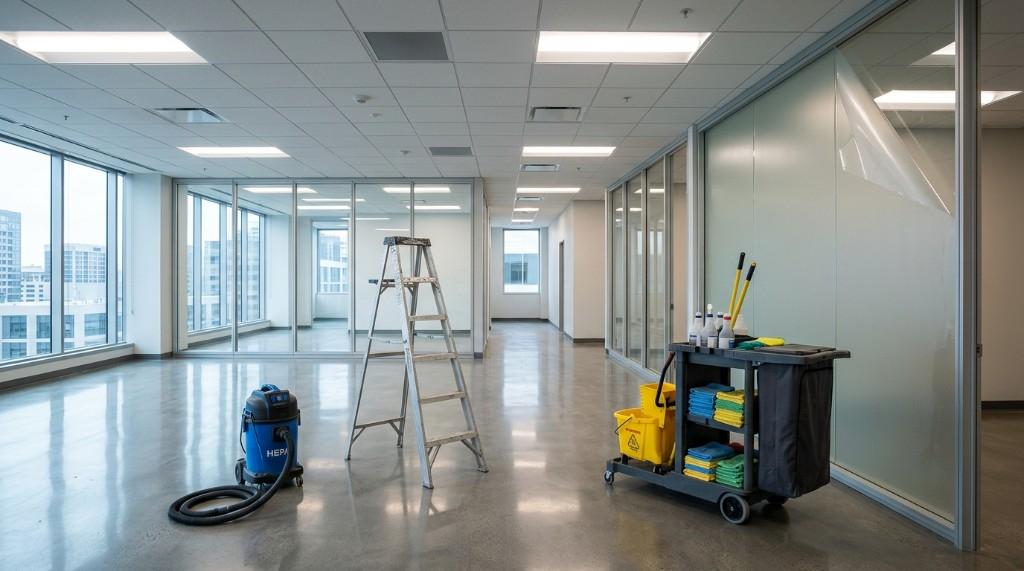
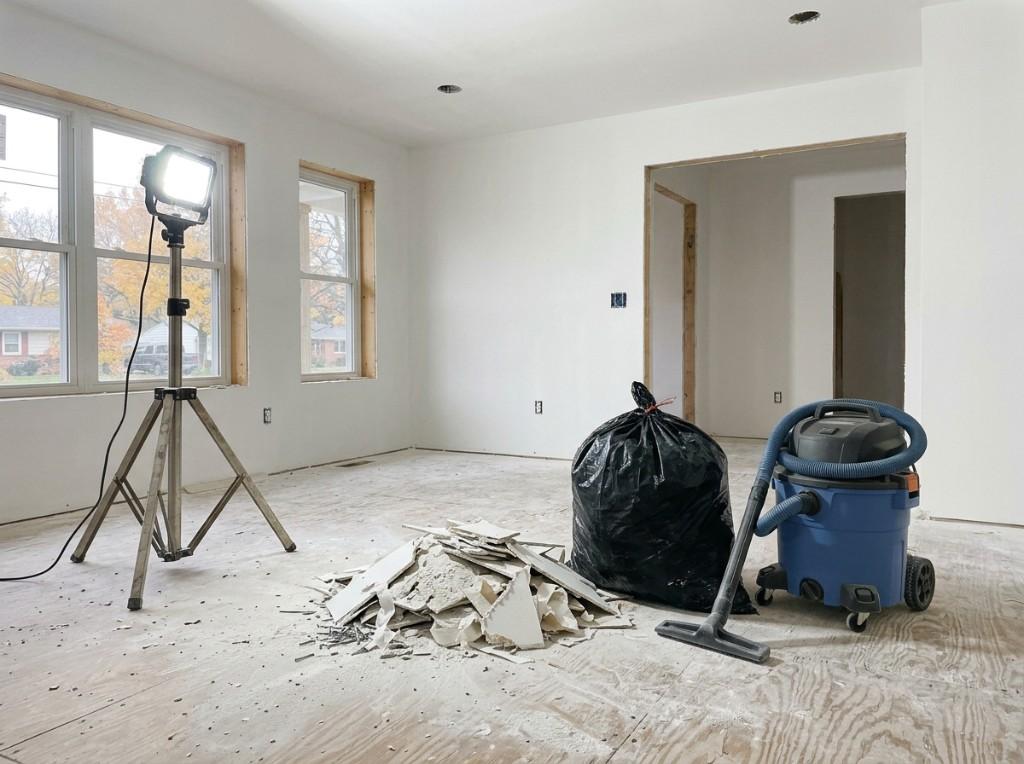
A rough clean happens once the heavy trades are done and before finishes go in. It clears debris and bulk dust so the finish trades start on a clean site. A final clean happens after every trade has left. It removes fine dust from every surface, top to bottom, takes off labels and residue, and gets the space ready for the punch-list walkthrough and handover. A touch-up (we call it a fluff clean) is a short visit a few days before move-in or opening. It catches the dust that settled after the final and the marks left by punch-list fixes.
Most residential remodels need only a final clean. New builds, additions and commercial fit-outs usually need all three. The short version of this sequence is also on our commercial post-construction page.
The three phases side by side
| Rough clean | Final clean | Touch-up (fluff) clean | |
|---|---|---|---|
| When | Heavy trades done: framing, mechanicals, usually drywall. Before flooring, cabinets and paint | Every trade finished. Before the punch-list walkthrough or inspection | A few days before move-in, opening day or listing photos |
| Goal | A clean site for the finish trades | A finished space, ready for handover | Day-one condition |
| Typical scope | Bulk debris cleared from work areas, HEPA-vacuumed subfloors and sills, packaging and stickers removed | Top-down HEPA vacuuming, two to three damp passes, inside cabinets and drawers, fixtures, glass, label and residue removal, vent covers and registers, floors by type | Flat surfaces, a final mop and vacuum, glass and mirror smudges, fingerprints from punch-list work |
| National price per sq ft | $0.15–$0.40 | $0.20–$0.60 | $0.25–$0.60 |
National prices: Fixr. Our own commercial rate is below.
When to call each phase
The order matters more than the date. A final clean that happens before the last dusty task gets repeated.
1Framing, mechanicals, insulation, drywall hang and finish
Rough clean2Prime and paint, flooring, cabinets, countertops, tile, trim
3Trim-out: devices, plumbing fixtures, hardware, appliances
4Painter’s last touch-ups and a decision on floor protection
Final clean5Punch-list walkthrough and fixes
6Handover, move-in or opening
Touch-up clean
“The final clean has to come after the last job that makes dust. If anyone is still sanding, cutting or drilling after us, we will be back.”
Who handles what
Most disputes about construction cleaning come from one question nobody asked: whose job is this? Settle it before the first visit.
| Item | Contractor / site | Cleaning crew |
|---|---|---|
| Debris haul-off | Dumpster or roll-off on site | We clear bulk debris from work areas in a rough clean. Hauling it off site stays with the contractor |
| Power, running water, working lights | Must be on before the final clean | We bring HEPA vacuums, ladders, tools and products |
| HVAC during the job | Seal returns during dusty work, run temporary filters, install new filters after the final | We wipe vent covers, registers and grilles. Deep duct cleaning goes to an HVAC contractor |
| Floor protection | Decide whether it stays or comes up before the final | We plan passes around your decision |
| High work that needs a lift or scaffold | Provide access | Flag it at the walkthrough so it’s in the plan |
| Exterior glass above the second story | Window contractor | Not included |
| Paint touch-ups, caulk, hardware | Trades, before the touch-up clean | Touch-up clean after them |
| Insurance | Request our COI | We send a certificate of insurance before site access |
How to write the cleaning scope
Specs put construction cleaning in Division 01 of CSI MasterFormat: 01 74 13 Progress Cleaning and 01 74 23 Final Cleaning. Typical spec language says final cleaning happens before final inspection, covers every interior and exterior surface the contractor had access to, new or existing, and should be done by experienced workers or professional cleaners (sample spec, Massachusetts DHCD).
On smaller jobs there is often no spec at all. That is when a one-page scope saves arguments. Copy this one and fill in the blanks:
SCOPE OF WORK — CONSTRUCTION CLEANING
Project: ____________________   Address: ____________________
Area: ______ sq ft   Stories: ___   Occupied during work: yes / no

Phases:  [ ] Rough   [ ] Final   [ ] Touch-up
Target dates:  Rough ________  Final ________  Touch-up ________

Site must be ready before the final clean:
  - All trades complete, including paint touch-ups
  - Debris removed from the building
  - Power, running water and lighting on
  - Floor protection: stays / removed by GC before the clean

Included: top-down HEPA vacuuming and damp wiping of all reachable
  surfaces; inside cabinets, drawers and appliances; fixtures; interior
  glass, frames and tracks; removal of labels, tape, paint specks and
  adhesive; vent covers and registers; floors by type

Excluded: debris haul-off; exterior glass above the 2nd story; duct
  cleaning; carpet extraction; lead, asbestos, mold or other hazmat

Method: HEPA vacuum before damp wipe. No dry sweeping or compressed air
  where it could spread silica dust (OSHA 29 CFR 1926.1153(f))

Insurance: certificate of insurance to GC before site access
Sign-off: walkthrough with the GC’s superintendent at the end of each phase
Construction dust is a safety issue, not only a finish issue
Drywall joint compounds are made from ingredients such as talc, calcite, mica, gypsum and silica. Breathing the dust can irritate the eyes, nose, throat and airways, and where silica is present it raises the risk of silicosis and lung cancer (NIOSH). One of NIOSH’s own drywall-dust evaluations was done on a renovation site in Buffalo (NIOSH HETA 94-0078-2660).
OSHA’s silica standard for construction does not allow dry sweeping or dry brushing where it could contribute to silica exposure, unless wet sweeping, HEPA vacuuming or other low-dust methods are not feasible. It restricts compressed air for cleaning surfaces the same way (Silica-Safe summary of 1926.1153(f)). That is why our crews HEPA-vacuum and damp-wipe, and never use brooms or blowers on construction dust.
There is a finish reason too. Drywall dust carries a static charge and clings to doors and trim. Wipe it wet first and it turns into a plaster-like paste that streaks fresh paint.
“On fresh paint, a wet rag first is how you turn dust into mud. We take the dust off dry, then finish damp.”
What it costs
Our commercial post-construction rate is $0.20–$0.40 per square foot, confirmed after a walkthrough (commercial price list).
| Project | Size | Estimate at $0.20–$0.40 per sq ft |
|---|---|---|
| Retail or medical suite fit-out | 1,500 sq ft | $300–$600 |
| Office floor | 5,000 sq ft | $1,000–$2,000 |
| Small warehouse with offices | 12,000 sq ft | $2,400–$4,800 |
What moves a job within that range: how many phases you book, ceiling height and high dusting, glass partitions and millwork, the amount of residue, and whether the space is occupied. For homes and the full list of price factors, see our post-construction cleaning price guide.
Six scheduling mistakes we see most
- Booking the final before the painter’s last touch-ups. Sanding and cutting in after the clean puts dust back on everything.
- Running HVAC without filters during sanding. Dust goes into the ducts and comes back out after the final clean.
- Leaving the floor-protection decision to the last day. Removing ram board after the final releases dust that has been sitting under it for weeks.
- No working lights. Fine dust is invisible in a dim room, for the crew and for your inspector.
- A final clean on the morning of the inspection. Leave at least a day for anything the walkthrough finds.
- No touch-up in the budget on a large job. Punch-list fixes always leave marks.
Two recent jobs
Retail pharmacy, Niagara Falls (commercial). After structural updates, the space had to be clean and sanitized before medical inventory arrived, with no interruption to the business. A four-person crew worked one overnight shift of about 12 hours, top-down: high dusting of HVAC vents, light fixtures and drop-ceiling grids, then shelving, counters and dispensing stations, then protective films, adhesive and contractor markings on glass partitions and casework, then multi-pass HEPA vacuuming of the carpet. The general contractor handed over the keys on schedule. Read the case.
“In commercial spaces, especially pharmacies, “clean” isn’t just an aesthetic — it’s a regulatory necessity.”
Two-story addition, Clarence (residential). The contractor handed over a family-room addition with new oak treads, LED trim and freshly painted doors under a layer of drywall dust and sawdust. Four cleaners spent two days on it: dry HEPA extraction from the top down, then flat-weave microfiber lightly misted with a pH-neutral cleaner, then hinges, handles and strike plates one by one. Read the case. Homeowners walking a finished remodel can also use the post-renovation checklist.
How to book us for your project
- Send the address, square footage, floors and target dates, or just the plans.
- We walk the site with you or your superintendent and confirm the price.
- You get our certificate of insurance before we arrive.
- We schedule the phases you need around your trades.
- At the end of each phase, our crew lead walks the space with you.
We serve Buffalo and Western New York, from Niagara Falls and Lockport to West Seneca and Lancaster.
Sources: Fixr — Post-Construction Cleaning Cost · Massachusetts DHCD — Section 01 74 13 sample spec · NIOSH — Control of Drywall Sanding Dust Exposures · NIOSH — Health Hazard Evaluation 94-0078-2660 · Silica-Safe — OSHA 1926.1153(f) housekeeping
Frequently asked questions
Book us for your project
Send the address, square footage, floors and target dates — or just the plans. We usually respond within 30 minutes.